Pearl’s Survival Story
I love telling the stories of my animal companions’ arrivals in my life, because their journeys reveal the innate goodness and resilience animals embody and humans should aspire to.
A few years ago, on a cold January night of weeklong below-freezing temperatures, Hans and I were sitting by the fire in our house in Alabama, watching TV. I heard a dog howling in distress outside. Thinking that our dog Georgia must have gotten out somehow and hurt herself, I jumped up and ran outside… with Georgia trotting right behind me.
Once my panic subsided, I realized that our dogs were all indoors and doing just fine. I stood on the front porch and listened, but the crying-dog sound had stopped. I went back inside and we resumed our TV-watching, but after a few minutes, I heard the high-pitched cry again. This time, I went outside with a flashlight and searched for the sound. It was coming from under the porch.
Our house was built on a slab, but the porch was on piers. Thinking of spiders, I held my flashlight in one hand, got down on my knees, and followed the whining sound into the dark crawlspace. I found the shivering little dog, a tiny golden tan blob in the darkness, huddled into a far corner of the house slab. When I reached for her, she rolled onto her back and screamed. Pretty sure she’d bite me, I took off my sweater and wrapped her in it, then picked her up. Holding her close—and shivering myself now because it was COLD without my sweater—I crawled out from under the porch and brought the pitiful little bundle into the house.
 We bathed her in warm soapy water, picking off dozens of fleas and ticks in the process. The number of parasites on such a tiny dog was astounding. But we got her cleaned up and wrapped her in a towel, then I sat by the fire and held her until her fur dried. We fed her canned cat food by the spoonful, then tried to get one of the dogs to cuddle with her, but they wanted nothing to do with her. This was unusual—our dogs are normally very welcoming to newcomers—but I didn’t think much about it. We tucked the little dog up next to our cat Princess Grace.
The next morning, I took the puppy to our vet, who estimated her age at about four weeks. She weighed three pounds. Starving, dehydrated, terrified, she was in no shape yet to be vaccinated, even if she had been old enough. The vet advised us to fatten her up and bring her back in a couple of weeks for her puppy shots.
But the next morning, she refused to eat. Not my first rodeo, I knew what that meant—she had Parvovirus or distemper. I took her to the vet, where a blood test confirmed Parvovirus. Parvo can be successfully treated with the human drug Tamiflu, if you begin treatment early enough. We had caught it in time, and she responded well to the medicine and an overnight vet stay for IV fluids. By the next morning, she was eating again and able to go home.
This time, the other dogs welcomed her. (They had known what we hadn’t, that she was carrying a highly contagious disease. Their own vaccinations would have protected them, but they didn’t know that.) After an early trial of the name Lambchop (because she was the size and color of Georgia’s Lambchop toy), we settled on the name Pearl. In part because her fur was the creamy blond color of a freshwater pearl, but also because the homely, old-fashioned name suited her reserved nature.
Pearl did not like being held. Whenever I picked her up, she squirmed awkwardly until I got her settled against me. Even then, she stayed as stiff as a board, ready to leap out of my arms at the first opportunity. She was more comfortable with dogs and cats than with people. To put it bluntly, she feared people, and for good reason.
I knew why, even though she didn’t communicate with me telepathically. (Fear is one of the biggest blocks to clear communication, and she was still afraid of me.) Our house was at the end of a quarter mile-long driveway from a dead-end dirt road where people often dumped whole litters of puppies and kittens.
Without a doubt, I knew that some A$$hole had taken her and her littermates away from their mother way too soon, driven them to our remote dead-end road at the edge of a fifty-acre wooded area, and dumped them.
Did they open the door and set the puppies gently on the ground so at least they’d be lost together? Or did they toss them one by one from the window of a moving vehicle? Either way, they dumped them. Either way, puppies that hadn’t even been fully weaned had been abandoned to fend for themselves, out of sight of any houses, without any hope of finding anyone to help.
What happened to Pearl’s littermates? We searched the woods along the road and near our house but found no stragglers. We alerted the neighbors to be on the lookout in case any puppies showed up at their houses. None did. Some may have died of Parvo, starvation, or below-freezing nights with no shelter. Others may have been picked off by predators or simply wandered in circles until they laid down to die. We’ll never know.
But our little Pearl made it through the wilderness alone to find us. That took more courage and willpower than a sickly, flea-and-tick-ridden, four-week-old, three-pound puppy ought to need. She wouldn’t have been able to run straight from the road to our house in one day, even if she’d known where to go. She’d have wandered a while, maybe for days, digging up grubs to eat (something she still does, bless her), and digging holes in the leaf litter to burrow into for warmth when the temperature dropped at night. (We’d had overnight temperatures in the teens for almost a week.)
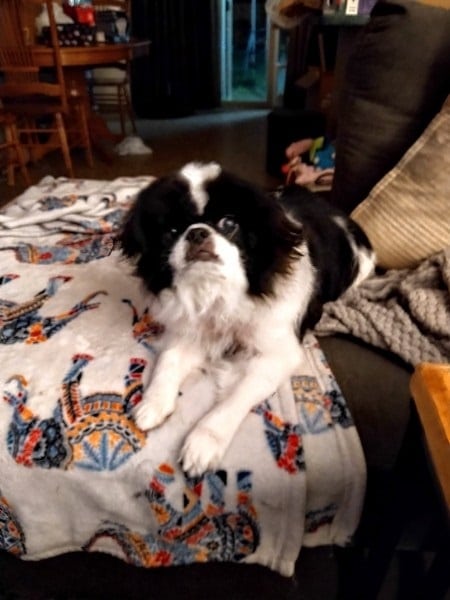
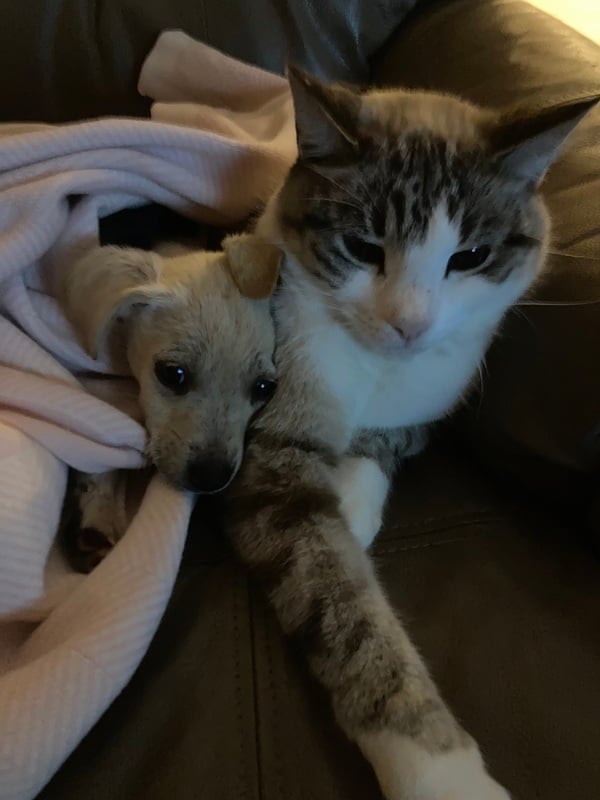 It’s no wonder that the photo of her with Princess Grace that first night clearly shows the horror of her ordeal reflected in her shell-shocked stare. She found us on January fourth. She might well have been terrorized by the flash and boom of New Year’s Eve fireworks along with everything else she had to endure.
It’s also no wonder that she had no love for human touch. I tried to overcome her reluctance by carrying her around in a baby sling just about every waking minute. We practiced picking her up and putting her down, so she’d get used to it and hopefully not cringe every time someone reached toward her. (We played the game of “pick-ee-up, put-ee-down,” over and over again, several times a day.)
Because of Covid, Pearl didn’t get as much socialization as our other dogs did. I often took her to the grocery store in her baby sling, but she hated every minute of it. She barked at any human who got too close, so I took her to the beach and asked the people we met there to say hi to her, so she’d get used to at least some human interaction beyond our family. She didn’t meet any children until she was two years old. Seeing a baby on its mother’s hip sent Pearl into barking hysterics: She was sure the baby was some sort of parasite that had glommed onto a human host. Subsequent meetings with children didn’t improve Pearl’s poor opinion of these loud, energetic, unpredictable creatures.
As a young puppy who knew what it was like to be freezing cold, Pearl loved wearing sweaters. Now that we live in an area of Hawaii where 70-degree weather is as cold as it gets, Pearl doesn’t need sweaters, but she still loves being tucked-in at night, and we keep blankets on her end of the couch to knock the chill off on early mornings, cool evenings, and rainy days. Being snuggled down in soft blankets is a comforting reminder to Pearl that she is safe, she is loved, and she is not alone.
Pearl has come a long way—not just across the Pacific, but even farther. Pearl has gone from being an abandoned and traumatized puppy, to becoming a happy, friendly, well-adjusted dog. She’ll still bark at anyone lurking outside the fence, but when we invite a friend to come in, they’re suddenly her new best friend. She still doesn’t enjoy being picked up, but she’ll happily come when called, and she’ll leap into the car or truck for a joyride (or a trip to the vet). She tolerates humans of all sorts and sizes now, even kids! She’ll hang back if a kid is bouncing around, and she won’t sit in anyone’s lap, but she’ll sit alongside someone who’ll gently fondle her ears. She likes playing with other dogs and cats, and she’s intensely curious about wild pigs, but we don’t let her meet them (because they may be cute, but they’re not always nice).
Pearl is an inspiring example to anyone struggling to get back up after being knocked down, to rise above when they’ve been held under, to learn new ways of being when the old ways have betrayed them.

Pearl’s resilience—her ability to recover from trauma and learn to trust again after being treated so cruelly, her willingness to overcome fear and replace it with curiosity, her determination to transform uncertainty into the joy of discovery—reminds me that my struggles and fears are wimpy compared to hers. If I could be as resilient as she is, I could overcome everything that’s held me back and move forward with a clear mind, an open heart, and a joyful spirit.
Whenever we “rescue” a stray, they rescue us right back. We may not realize it right away, especially when we’re busy dealing with their health issues, the extra vet bills we hadn’t planned for, and the uncertainty of where they belong, how they’ll impact our lives, or whether they’ll fit into our current family dynamics.
Bottom line: If they need your help, you need theirs. If an animal in need of help appears to you, they’re a gift from the universe.
Ignore the gift if it’s too much trouble. Pretend you didn’t see it if you’re in too much of a hurry. That’s your business. But gifts from the universe often come in unexpected packages: The skittish kitten hiding under your car in the grocery store parking lot. The skinny, mangy dog you see darting into traffic when you’re already late for work. The terrified, diseased, flea-infested puppy hiding under your porch.
You may not know the blessings you’ll gain by helping them until much later. And maybe you never will. But if you decide to look the other way, pass them by, ignore their plight, you’ll never know the gifts they had to give, the wisdom they had to share, or the important connections they may have offered to benefit you and enrich your life.
The Bible asks us to be willing to help strangers in need, because they may in fact be angels who’ve come here to help us, even though we may not be aware of their divine connection to God. Various scriptures word this in many ways. Some frame it as a challenge, others as a trap. I think of it as a promise. Angels are just as likely to incarnate as animals as humans. They’ll come in whatever way we need to see them. And they’ll bring whatever lessons we need to learn, followed by the gifts we’re ready to receive. The animals with whom we share this planet are always here for us. The only question is, are we here for them too?